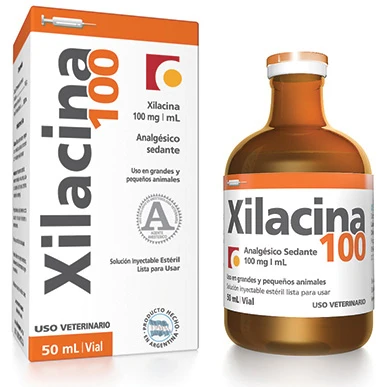
Xilacina 100
Laboratorio:
Richmond
$39.90
Out of stock
USD
/ unidad
El presupuesto final se adapta según el volumen solicitado y el destino de entrega.
- Distribución oficial habilitada por SENASA Establecimiento oficial y normativas sanitarias vigentes
- Cadena de frío garantizada Monitoreo térmico para biológicos y sueros
- Dirección técnica y asesoramiento veterinario Atención profesional especializada en medicina equina
- Envíos nacionales e internacionales especializados Acondicionamiento térmico y logística segura
Xilacina 100
$39.90
USD
Out of stock
XILACINA 100 Potent sedative, muscle relaxant, and non-narcotic analgesic. Xylacine hydrochloride: 10 g. Carriers and excipients q.s.: 100 ml. ACTION : Potent sedative, muscle relaxant, and non-narcotic analgesic. The sedative and analgesic effects are related to central nervous system depression. The muscle-relaxing effect is based on the inhibition of intraneural impulse transmission in the central nervous system; The main effects develop within 10 to 15 minutes after intramuscular injection and within 3 to 5 minutes after intravenous injection. A sleep-like state, the depth of which depends on the dose, lasts 1 to 2 hours, while analgesia lasts 15 to 30 minutes after administration. Following intramuscular injection, the drug is rapidly absorbed, but bioavailability varies by species: in horses, it ranges from 40 to 48%; In sheep, between 17 and 73%; And in dogs, between 52 and 90%. INDICATIONS Minor, short-duration surgical procedures, such as suturing lacerations or debridement. As a pre-anesthetic agent, thereby reducing the required dose of anesthetic agents. Orthopedic procedures, clinical examination of the mouth and ears, and abdominal, rectal, or vaginal palpation. Catheterization and X-rays. Dentistry. Used in conjunction with local anesthetics. CONTRAINDICATIONS AND WARNINGS Do not administer to animals receiving epinephrine or that have ventricular arrhythmias. Use with caution in animals with preexisting cardiac dysfunction, hypotension, or shock; Respiratory dysfunction; Or severe renal or hepatic insufficiency. Do not administer to severely debilitated animals. Do not administer to dehydrated ruminants or those with urinary tract obstruction. May cause premature labor; Do not use during the last trimester of gestation. Animals must be handled carefully after administration; A false sense of security may lead to an accident, as animals may react defensively. SIDE EFFECTS In dogs, bradycardia, heart block, and acute arterial hypotension may occur, as well as apparent tympanism due to aerophagia. Because it induces a marked degree of salivation in ruminants, premedication with atropine is recommended. DOSAGE : Administer subcutaneously (SC), intramuscularly (IM), or intravenously (IV). Specific doses will depend on the conditions of use and administration. Horses: Intravenous (IV) 0.5 to 1.1 mg/kg, equivalent to 0.5 to 1.1 mL per 100 kg of body weight; Intramuscular (IM) 1 to 2 mg/kg, equivalent to 1 to 2 mL per 100 kg of body weight. Cattle: Intravenous (IV) 0.03 to 0.1 mg/kg, equivalent to 0.03 to 1 ml per 100 kg of body weight; Intramuscular (IM) 0.1 to 0.2 mg/kg, equivalent to 0.1 to 0.2 mL per 100 kg of body weight. Sheep: Intravenous (IV) 0.5 to 1.1 mg/kg, equivalent to 0.005 to 0.01 ml per 10 kg of body weight; Intramuscular (IM) 0.1 to 0.3 mg/kg, equivalent to 0.01 to 0.03 ml per 10 kg of body weight. Goats: Intravenous (IV) 0.01 to 0.5 mg/kg, equivalent to 0.001 to 0.05 ml per 10 kg of body weight; Intramuscular (IM) 0.05 to 0.5 mg/kg, equivalent to 0.005 to 0.05 ml per 10 kg of body weight. Pigs: Intramuscular (IM) 2 to 3 mg/kg, equivalent to 0.2 to 0.3 ml per 10 kg of body weight. Dogs: Intravenous (IV) 0.5 to 1 mg/kg, equivalent to 0.05 to 0.1 ml per 10 kg of body weight; Intramuscular (IM) 1 to 2 mg/kg, equivalent to 0.1 to 0.2 mL per 10 kg of body weight. Cats: Intravenous (IV) 0.5 to 1 mg/kg, equivalent to 0.025 to 0.05 ml per 5 kg of body weight; Intramuscular (IM) 1 to 2 mg/kg, equivalent to 0.05 to 0.1 mL per 5 kg of body weight. Poultry: Intramuscular (IM) 5 to 10 mg/kg, equivalent to 0.05 to 0.1 mL per 1 kg of body weight
Laboratory
Richmond
Categories
Pain relievers