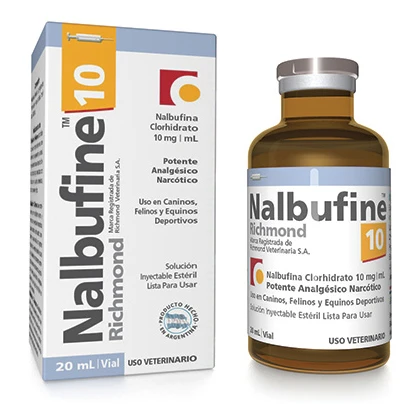
Nalbufine 10
Laboratorio:
Richmond
$56.92
Out of stock
USD
/ unidad
El presupuesto final se adapta según el volumen solicitado y el destino de entrega.
- Distribución oficial habilitada por SENASA Establecimiento oficial y normativas sanitarias vigentes
- Cadena de frío garantizada Monitoreo térmico para biológicos y sueros
- Dirección técnica y asesoramiento veterinario Atención profesional especializada en medicina equina
- Envíos nacionales e internacionales especializados Acondicionamiento térmico y logística segura
Nalbufine 10
$56.92
USD
Out of stock
NALBUFINE 10 Narcotic analgesic, in a sterile injectable solution for use in sport horses, dogs, and cats. Nalbuphine hydrochloride: 1 g. Excipients q.s.: 100 mL. ACTION : Narcotic analgesic. Nalbufine hydrochloride is a synthetic phenanthrene chemically related to naloxone (a narcotic antagonist) and oxymorphone (a morphine agonist analgesic). Nalbufine 10 is used as a narcotic analgesic for the management of somatic and/or visceral pain. It is used to potentiate the sedative effect of major (phenothiazines) and minor (benzodiazepines) tranquilizers. It can also be combined with NSAID-type analgesics (nonsteroidal anti-inflammatory drugs) and may be used in conjunction with anesthetic or hypnotic agents (propofol, sodium thiopental, ketamine, halothane). Bioactivity: Nalbufine 10 is an opioid analgesic with agonist/antagonist activity that is equipotent with morphine (1:1). It has a rapid onset of action, and its half-life is longer when administered subcutaneously. Nalbuphine has a strong agonist effect on kappa receptors and a strong antagonist effect on mu receptors. Its agonist effect on sigma receptors is minimal, and it has no effect on delta and epsilon receptors. INDICATIONS As a general indication, Nalbufine 10 is indicated for the management of mild to moderate pain. As part of preanesthetic medication: Nalbufine 10 can be combined with major and minor tranquilizers and analgesics used in preanesthetic medication, enhancing their sedative effect. Doses of major tranquilizers (acepromazine) may be reduced by up to 70% depending on the case (particularly in large and/or debilitated dogs). In sport horses, it can be combined with romifidine without altering the cardiovascular effects produced by romifidine. Intraoperative: The use of Nalbufine 10 is indicated when, for any reason, it is necessary to enhance analgesia during surgery without deepening the anesthetic plane. (The attending veterinarian is advised to pay particular attention to monitoring respiratory function for 10 minutes following the administration of nalbuphine to detect any respiratory depression. ) Minor Surgery: Nalbufine 10 may be combined with a hypnotic agent (midazolam, propofol, thiopental) or a dissociative anesthetic (ketamine) for minor surgical procedures or invasive diagnostic procedures. These protocols may be supplemented with the use of local anesthetics (bupivacaine, lidocaine), with the decision to use them left to the discretion of the attending veterinarian. Postoperative Analgesia: Nalbufine hydrochloride is indicated for the management of postoperative pain of somatic and/or visceral origin. Trauma Patients and Critically Ill Patients: Nalbufine 10 may be used in patients in shock of any origin or type, as well as in patients with heart failure of valvular and/or myocardial origin. Patients with gastric dilatation-torsion-volvulus (GDTV) show marked improvement when administered Nalbufine 10 alone (parenteral or epidural) or in combination with flumixine megluminate. The use of Nalbufine 10 is indicated in trauma patients with single or multiple fractures and/or dislocations. In patients with floating chest syndrome and respiratory failure, Nalbufine 10 should be administered intrathoracically in combination with bupivacaine. Parenteral administration may exacerbate respiratory failure; Its use is at the discretion of the treating professional following a careful assessment of the risk-benefit ratio. Nalbufine 10 is highly effective for the management of pain caused by burns of any type and degree. Nalbufine 10 is indicated for the management of pain caused by ocular trauma. In sport horses, it is highly effective for managing pain caused by colic, either alone or in combination with flumixine megluminate. It is also useful for managing pain caused by equine degenerative joint disease and osteoarticular pain in general. As a morphine antagonist: Additionally, Nalbufine 10 is indicated to partially reverse the effects of pure morphine agonists (morphine, fentanyl, etc.) while preserving their analgesic action without the side effects of naloxone (a morphine antagonist). Reversal of the effects of morphine agonists does not pose any risk of renarcosis. CONTRAINDICATIONS AND WARNINGS In patients with drowning syndrome, nalbuphine hydrochloride may exacerbate the condition . The use of nalbuphine is contraindicated in patients with a history of hypersensitivity to the drug. In patients with traumatic brain injury and/or spinal cord injury, as it may cause local vasoconstriction and worsen the condition. Patients with severe respiratory depression. Feline patients with asthma. Patients with severe hepatic or renal dysfunction. Studies conducted on fertility and reproductive capacity in rats revealed no effect of nalbuphine on these functions. Teratogenicity studies in rats did not reveal any defects; However, its use in pregnant females is recommended with extreme caution until further scientific information is available. Interactions: Nalbuphine may interfere with the prokinetic action of metoclopramide. Concomitant use of Hydroxyzine and Nalbufine 10 may potentiate the analgesic and CNS-depressant effects. When used in combination with anesthetics or hypnotics, the dose of these agents should be reduced. Do not mix in the same syringe or container with any substance other than the product . Destroy the container after use and dispose of it in designated waste collection bins. Protect the environment. Do not ingest; Keep out of the reach of children. SIDE EFFECTS Poisoning and Overdose: In the event of an iatrogenic overdose, the following is recommended: hemodialysis, peritoneal dialysis, and appropriate symptomatic treatment as determined by the attending veterinarian. Suggested antidote: Dogs: Naloxone 0.04 mg/kg IM, IV, or SC. Cats: Naloxone 0.05 to 0.1 mg/kg IV. Sport horses: Naloxone 0.01 to 0.022 mg/kg IV. DOSAGE Combinations: With Acepromazine: Dogs: 0.03–0.08 mg/kg intramuscularly of Acepromazine, 1–2 mg/kg intramuscularly or intravenously of Nalbuphine, equivalent to 0.1 to 0.2 mL/kg. Feline: 0.05–0.2 mg/kg of acepromazine, 1–2 mg/kg intramuscular or intravenous nalbuphine, equivalent to 0.1 to 0.2 mL/kg. With Diazepam: Dogs: 0.3–0.5 mg/kg of diazepam administered intramuscularly; 1–2 mg/kg of nalbuphine administered intramuscularly or intravenously, equivalent to 0.1–0.2 ml/kg. Feline: 0.1–0.3 mg/kg intramuscular diazepam, 1–2 mg/kg intramuscular or intravenous nalbuphine, equivalent to 0.1–0.2 ml/kg. With midazolam: Dogs: 0.066–0.22 mg/kg of midazolam, 1–2 mg/kg of nalbuphine, equivalent to 0.1–0.2 ml/kg, administered intramuscularly or intravenously. Feline: Same as for dogs. With Flumixine Meglumine: Dogs: 0.5–1 mg/kg of flumixine megluminate intramuscularly, 0.4–2 mg/kg of nalbuphine intramuscularly or intravenously, equivalent to 0.04–0.2 mL/kg. Epidural administration: Nalbufine 10 can be administered epidurally because it contains no preservatives. To be administered by this route, the total dose of Nalbufine 10 must be diluted in the same syringe with a volume of 0.05–0.15 ml/kg of body weight (maximum 3 ml) of normal saline. Dogs: 0.5 to 1 mg/kg, equivalent to 0.5 to 1 ml per 10 kg of body weight. Horses: 20 mg per 100 kg, equivalent to 1.0 to 2.0 ml per 100 kg of body weight. With Romifidine: Sport horses: 0.08 mg/kg of Romifidine, 0.3 mg/kg of Nalbuphine, equivalent to 0.03 ml/kg, administered intravenously. This combination is characterized by inducing sedation, moderate ataxia, and head drooping. Combination with Nalbufine 10 does not alter the cardiovascular effects produced by romifidine. When romifidine is combined with meperidine, an increase in heart rate and a decrease in MAP (mean arterial pressure) are observed. NOTES : Nalbufine can be used in combination with various drugs (Acepromazine, Diazepam, Midazolam, Flunixin Meglumine), depending on the chosen anesthetic protocol
Laboratory
Richmond
Categories
Pain relievers