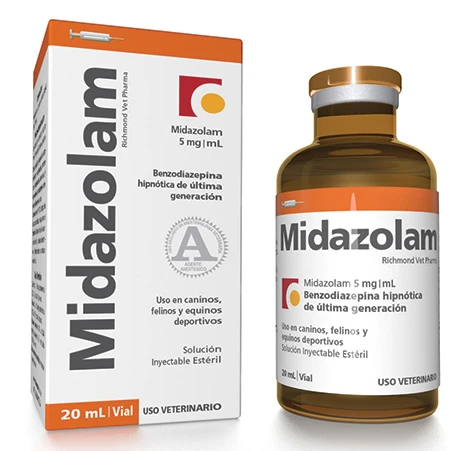
Midazolam
Laboratorio:
Richmond
$26.40
Out of stock
USD
/ unidad
El presupuesto final se adapta según el volumen solicitado y el destino de entrega.
- Distribución oficial habilitada por SENASA Establecimiento oficial y normativas sanitarias vigentes
- Cadena de frío garantizada Monitoreo térmico para biológicos y sueros
- Dirección técnica y asesoramiento veterinario Atención profesional especializada en medicina equina
- Envíos nacionales e internacionales especializados Acondicionamiento térmico y logística segura
Midazolam
$26.40
USD
Out of stock
A latest-generation benzodiazepine hypnotic in a sterile, ready-to-use injectable solution for horses, dogs, and cats. Midazolam: 0.5 g. Excipients q.s.: 100 mL. ACTION Midazolam is a member of the latest generation of benzodiazepines and may be used as an anxiolytic, tranquilizer, sedative, hypnotic, anticonvulsant, and muscle relaxant. Midazolam is twice as potent as diazepam and has half the toxicity. Midazolam has unique solubility characteristics; It is water-soluble in its original formulation and fat-soluble at body pH, which allows for rapid onset of action following injection. Midazolam is a fast-acting hypnotic benzodiazepine; Its effect lasts 2 to 4 hours, which facilitates the drug’s administration and control of its effects. It shortens the time required for induction of anesthesia, allowing for reduced doses of induction and maintenance agents (halothane). Midazolam enables the patient to awaken calmly and with a clear head. Bioactivity: Midazolam acts selectively on polysynaptic neural pathways mediated by GABA (gamma-aminobutyric acid) or glycine. Midazolam exerts its action throughout the central nervous system, and its inhibitory action is almost exclusively presynaptic. This presynaptic inhibitory action has the same potency as that of diazepam, but the efficacy of midazolam is, as mentioned, much greater. Midazolam acts primarily on the ascending reticular activating system (ARAS), and its action on this center is responsible for its anxiolytic, tranquilizing, hypnotic, and sedative effects. The hypnotic effect of midazolam results from the depression of cortical centers, and muscle relaxation is primarily due to the depression midazolam causes in the spinal motor centers. Pharmacokinetics: Following intramuscular injection, midazolam is rapidly and almost completely absorbed (91%). Although there are no oral formulations containing the drug, midazolam is well absorbed following oral administration; However, due to its rapid first-pass effect, its bioavailability ranges from 31% to 72%. The onset of action following IV administration is very rapid due to the agent’s high lipophilicity. The drug has a high affinity for plasma proteins (94–97%) and rapidly crosses the blood-brain barrier. Midazolam is metabolized in the liver, primarily by microsomal oxidation. Its active metabolite has a very short half-life and low pharmacological activity; Therefore, it does not produce clinical effects. The serum half-life and duration of action of midazolam are considerably shorter than those of diazepam. INDICATIONS It is indicated for use alone or in combination with analgesics, parasympatholytics, and anesthetic agents according to various protocols. Midazolam exerts a very rapid, intense, and brief sedative and hypnotic effect. It also has anxiolytic, anticonvulsant, tranquilizing, and muscle-relaxing properties. As part of preanesthetic medication, it can be used alone or in combination with analgesics, parasympatholytics (atropine), etc. For diagnostic and minor surgical procedures: it may be combined with ketamine or xylazine. As an anesthetic inducer in normal patients and critically ill patients: combined with ketamine, thiopental, propofol, etc. For minor surgery in cats: combined with acepromazine or ketamine. In canine patients with heart disease. Thoracic surgery in dogs. Intraocular surgery in horses. Muscle spasms: in patients with post-traumatic sympathetic syndrome, in patients with pain syndrome due to disc disease. When compared to thiobarbiturate induction agents (thiopental), midazolam exerts a lesser cardiopulmonary depressant effect; It is water-soluble, can be mixed with other agents, and does not tend to accumulate in the body after repeated doses. CONTRAINDICATIONS AND WARNINGS Do not administer to patients with a history of hypersensitivity to the drug, severe hepatic insufficiency, severe renal insufficiency, to pregnant women, or to debilitated or elderly patients. Patients with congestive heart failure may eliminate the drug more slowly. Midazolam may be administered with caution to patients in a coma, in shock, or with significant respiratory depression. A 12-hour fast from both food and liquids is recommended prior to the administration of general anesthetics; In summer, the liquid fasting period may be reduced to 6 hours. It should be noted that fasting has adverse effects in some species. Some mammals, birds, and neonates may develop hypoglycemia after just a few hours of fasting, and the mobilization of glycogen stores can alter metabolic parameters and drug clearance. The latter is an important factor in ruminants. In contrast, feeding dogs prior to induction increases the metabolic rate for more than 18 hours. Inducing anesthesia in an animal with a full stomach should be avoided, if possible, due to the risk of aspiration. Drug Interactions: Midazolam may potentiate the central depressant effect when administered concurrently with antipsychotics, hypnotics, anxiolytics, antidepressants, analgesics, narcotics, antiepileptics, anesthetics, and sedating antihistamines. There is a potentially significant interaction between midazolam and compounds that inhibit certain liver enzymes (particularly cytochrome P450 3A). Experience clearly indicates that these compounds alter the pharmacokinetics of midazolam and may induce prolonged sedation. This reaction has been observed to date with cimetidine, erythromycin, verapamil, ketoconazole, and itraconazole. Therefore, patients receiving the aforementioned compounds and others that inhibit CYP3A in combination with midazolam should be carefully monitored during the first few hours after midazolam administration (studies have shown that ranitidine does not affect the pharmacokinetics of parenteral midazolam). In an in vitro study, numerous substances (including cyclosporine, amiodarone, and neuroleptics) inhibited the hydroxylation of midazolam, suggesting that, theoretically, interactions with many medications are possible. Midazolam potentiates the effects of barbiturates, neuroleptics, diphenylhydantoin, and phenobarbital. When midazolam ampoules are administered in combination with potent analgesics, the analgesics should be administered first, since the midazolam dose—based on its sedative effects—can be adjusted more safely in relation to the sedation caused by the analgesic used. Precautions: Midazolam ampoules should be used only if adequate resuscitation equipment is available. Verify that the product’s tamper-evident seal and storage conditions are appropriate prior to use. The suggested doses and warnings in all cases are subject to the discretion of the attending veterinarian. Store the product at 5–30°C, protected from direct sunlight, in a dry and hygienic place. Dispose of administration waste and disposable materials in containers for pathogenic waste. Do not ingest. Keep out of the reach of children. Sold exclusively by prescription to licensed veterinarians. SIDE EFFECTS Rumen distension in small and large ruminants impairs normal ventilation, leading to hypoxemia and hypercapnia. Midazolam causes respiratory depression; The severity of this depends on the rate of administration, which must never be less than 30 seconds; Otherwise, apnea may occur. DOSAGE Suggested maximum dose of Midazolam: up to 1 mg/kg. Hypnotic dose: in all species, to achieve a hypnotic effect, the doses suggested above should be doubled. Unlike Diazepam, its intramuscular administration is very well tolerated, as is its response. At these doses and when using midazolam as anesthetic premedication, the dose of induction agents (barbiturates) should be reduced by up to 50% of the dose calculated without premedication for those agents. Minor Diagnostic and Surgical Procedures: Induction of Anesthesia: These protocols may be supplemented with infiltration local anesthesia for minor surgical procedures or with epidural or regional anesthesia. Midazolam/Ketamine: Midazolam 0.28 mg/kg intravenously, equivalent to 0.056 ml/kg + Ketamine 5.6 mg/kg intravenously. Midazolam/Thiopental: Midazolam 0.28 mg/kg intravenously, equivalent to 0.056 ml/kg + thiopental 3 to 8 mg/kg intravenously. Midazolam/Propofol: Midazolam 0.28 mg/kg intravenously, equivalent to 0.056 ml/kg + Propofol 2 mg/kg administered slowly intravenously. Administer supplemental doses of Propofol at 0.5 mg/kg every 60 seconds until the eyelid reflex disappears. For outpatient surgery in: Cats: Protocol A: Acepromazine 0.01 mg/kg, Midazolam 1 mg/kg (0.2 ml/kg), Ketamine 20 mg/kg, Fentanyl 0.02 mg/kg, administered intramuscularly. Onset: 4.5 ± 0.7 min. Analgesia: 50 ± 6 min. Head movements: 54 ± 9 min. Recovery: 83 ± 13 min. Protocol B: Acepromazine 0.01 mg/kg, Midazolam 1 mg/kg (0.2 ml/kg), Ketamine 20 mg/kg, administered intramuscularly. Latency: 4 ± 1 min. Analgesia: 54 ± 12 min. Head movements: 57 ± 9 min. Recovery: 85 ± 18 min. In canine patients with heart disease: Hypertrophic cardiomyopathy: Premedication: Midazolam 0.1 mg/kg (0.02 ml/kg), Nalbuphine 0.4 mg/kg, administered intramuscularly. Induction: Thiopental 3 to 8 mg/kg intravenously or Propofol 1 to 2 mg/kg intravenously with supplemental doses of 0.5 mg/kg every 60 seconds. Maintenance: Halothane + oxygen. Dilated Cardiomyopathy: Premedication: Midazolam 0.1 mg/kg intramuscularly (0.02 mL/kg). Induction: Thiopental 3 to 8 mg/kg intravenously or Propofol 1 to 2 mg/kg intravenously with supplemental doses of 0.5 mg/kg every 60 seconds. Maintenance: Halothane 0.5 to 1.5% + oxygen. For continuous infusion: For thoracic surgery in dogs: Midazolam 0.55 µg/kg/min + fentanyl 0.7 µg/kg/min. For intraocular surgery in horses: Premedication: Romifidine 0.08 mg/kg intravenously. Induction: Glyceryl guaiacolate ether 100 mg/kg + midazolam 0.1 mg/kg + ketamine 1 mg/kg, intravenously. Maintenance: Halothane + oxygen. No increases in intraocular pressure have been reported with this protocol. Muscle spasms: In patients with post-traumatic sympathetic syndrome. In patients with pain syndromes due to discopathies. Midazolam may be administered intramuscularly in combination with NSAIDs (aspirin, phenylbutazone, meloxicam, flumixine megluminate, etc.). The administration interval for repeated treatments in the indicated species is 2 to 4 hours. NOTES : Various anesthetic protocols may be used, combining different drugs and adjusting doses on a case-by-case basis
Laboratory
Richmond
Categories
Anesthetics