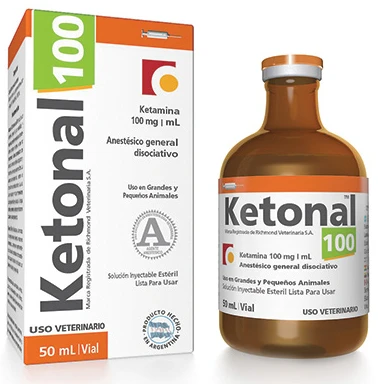
Ketonal 100
Laboratorio:
Richmond
$37.80
Out of stock
USD
/ unidad
El presupuesto final se adapta según el volumen solicitado y el destino de entrega.
- Distribución oficial habilitada por SENASA Establecimiento oficial y normativas sanitarias vigentes
- Cadena de frío garantizada Monitoreo térmico para biológicos y sueros
- Dirección técnica y asesoramiento veterinario Atención profesional especializada en medicina equina
- Envíos nacionales e internacionales especializados Acondicionamiento térmico y logística segura
Ketonal 100
$37.80
USD
Out of stock
A fast-acting, dissociative general anesthetic; Aqueous injectable solution for use in large and small animals. COMPOSITION Ketamine hydrochloride: 10 g. Excipients q.s.: 100 ml. ACTION Ketonal 100 is a fast-acting, non-barbiturate, non-narcotic general anesthetic, non-barbiturate, non-narcotic general anesthetic, chemically designated as dl-2-(o-chlorophenyl)-2-(methylamino)cyclohexanone hydrochloride, in a solution stabilized at a slightly acidic pH (3.5 to 5.5) suitable for injection. It is an aqueous injectable solution containing the equivalent of 100.0 mg of ketamine hydrochloride USP per mL of sterile injectable solution. Pharmacokinetics: After intramuscular administration in felines, the drug reaches its peak concentration in approximately 10 minutes. Ketamine is rapidly distributed throughout all body tissues, achieving high concentrations in the brain, liver, lungs, and adipose tissue. Its plasma protein binding is estimated at 50% in equines, 53% in dogs, and between 37% and 53% in cats. Ketamine is metabolized in the liver, primarily by demethylation and hydroxylation, and its metabolites are excreted unchanged in the urine. The drug elevates levels of hepatic microsomal enzymes, although this has no clinical significance. The elimination half-life in dogs, cats, cattle, and horses is 1 hour. As with barbiturates, the redistribution of ketamine outside the central nervous system is, in this case, the most important factor to consider when determining the duration of anesthesia. Bioactivity: Ketonal 100 is a fast-acting anesthetic agent, and its pharmacological action in the body is characterized by profound analgesia, the presence of laryngeal and pharyngeal reflexes, moderate cardiovascular stimulation, and respiratory depression. At high doses, the respiratory rate typically decreases in almost all species. Skeletal muscle tone varies, ranging from normal to increased or decreased. This condition is dose-dependent, and variations in the patient’s body temperature associated with muscle tone may be observed. At low doses, muscle tone may increase, coinciding with a slight rise in body temperature. At high doses, a certain decrease in muscle tone may be observed, resulting in a drop in body temperature—to such an extent that hypothermia must sometimes be counteracted by providing the patient with a source of heat. The states of anesthesia produced by ketamine do not fit into the conventional classification of common anesthetic levels; Rather, it produces a state of unconsciousness known as dissociative anesthesia because its presence appears to selectively interrupt the transmission of stimuli to the brain before producing somatic-sensory block. Ketamine induces anesthesia and amnesia through a functional disruption in the CNS, either by overstimulating it or by inducing a cataleptic state in the patient. Ketamine inhibits GABA and is also capable of blocking serotonin, norepinephrine, and dopamine at the CNS level. The thalamocortical system is depressed, while the limbic system is activated. It induces anesthesia at levels 1 and 2 but never at level 3. In contrast to other anesthetics, ketamine leaves defensive reflexes—such as the cough reflex and the swallowing reflex—intact. The advantage of not blocking pharyngeal and laryngeal reflexes ensures that the patient’s upper airways remain patent. Occasional salivation may be observed, but the presence of the swallowing reflex protects against the dangers associated with excessive salivation in anesthetized patients. Salivation can be effectively controlled by administering atropine sulfate at a dose of 0.04 mg/kg in cats and dogs. In cats, it is common to observe transient cardiovascular stimulation, increased cardiac output, a slight rise in systolic blood pressure, and a minor increase in total peripheral resistance. Other reflexes, such as the corneal and plantar reflexes, remain present throughout anesthesia and should not be taken as indicators of the level or depth of anesthesia. The patient’s eyes typically remain open and dilated; In cases of prolonged anesthesia, the use of some type of ophthalmic ointment is recommended to protect the cornea. At the recommended doses, cats exhibit ataxia 5 minutes after administration of the drug, followed by a period of anesthesia lasting 30 to 45 minutes at higher doses. At low doses, the patient’s full recovery occurs within 4 to 5 hours; However, at high doses, the period of full recovery is prolonged to 24 hours. Compatibility: Ketamine may be mixed with water for injection, 5% dextrose solution, and normal saline. It may be combined with xylazine in the same syringe. INDICATIONS Short-term general anesthesia. As a single or combination anesthetic agent. To immobilize the patient for the purpose of performing brief surgical procedures or minor diagnostic procedures that do not require muscle relaxation. For anesthesia in high-risk patients, as it does not compromise the animal’s cardiorespiratory system. For cesarean section due to the absence of fetal toxicity. CONTRAINDICATIONS AND WARNINGS To reduce the incidence of adverse reactions during recovery from ketamine anesthesia, the patient should be monitored and kept in a warm, dark place, protected from noise and environmental disturbances during recovery. The pupils should be protected with ophthalmic ointment to prevent excessive dryness during ketamine anesthesia. A 12-hour fast from both food and fluids is recommended prior to the administration of general anesthetics; However, in the summer, the fluid fasting period may be reduced to 6 hours. It should be noted that fasting has adverse effects in some species. Some mammals, birds, and neonates may develop hypoglycemia after just a few hours of fasting, and the mobilization of glycogen stores can alter metabolic parameters and drug clearance. The latter is an important factor in ruminants. In contrast, feeding dogs prior to induction increases the metabolic rate for more than 18 hours. Induction of anesthesia in an animal with a full stomach should be avoided, if possible, due to the risk of aspiration. Rumen distension in small and large ruminants impairs normal ventilation, leading to hypoxemia and hypercapnia. Although restricting food intake does not empty the rumen, the likelihood of regurgitation is reduced if the animal is also fasted from liquids for 12–24 hours prior to anesthesia induction. In horses, a full stomach may rupture during induction; Therefore, a fast from both solid and liquid food and water for at least 6 hours is recommended. In very young animals and also in geriatric patients, water is usually offered until the very last moment before the administration of preanesthetic agents. It should be noted that it is common for many geriatric dogs to suffer from nephritis; These patients are already in a state of compensation below normal levels, and the stress of hospitalization, water deprivation, and anesthesia—sometimes even without surgery—can lead to acute decompensation. Normal diuresis can be restored by administering fluids via continuous IV infusion prior to the administration of anesthetic drugs. In any case, it is good anesthetic practice to administer IV fluids during anesthesia to help maintain adequate blood pressure and urine output, as well as to provide a patent route for drug administration. Preoperative systemic administration of broad-spectrum antibiotics (e.g., IV sodium ampicillin) is a useful prophylactic measure prior to major surgeries or in cases where there is an imminent risk of contamination at the surgical site. Do not mix ketamine with barbiturates or diazepam in the same syringe, as they precipitate. Because ketamine does not provide adequate muscle relaxation, its use as a sole anesthetic agent in major surgeries is contraindicated. Ketamine is contraindicated in animals with hepatic or renal insufficiency. Ketamine is contraindicated in patients who have demonstrated hypersensitivity reactions to the active ingredient. Its use in patients with significant hypertension, heart failure, and arterial aneurysms may be risky. It is relatively contraindicated in cases of increased intraocular pressure or preexisting injuries to the eyeball, as well as for procedures involving the pharynx, larynx, or trachea. In animals that have lost large amounts of blood, it is recommended to significantly reduce the ketamine dose. Ketonal 50 must be administered using a hypodermic needle and syringe, adhering to all appropriate aseptic and antiseptic standards to maintain the sterility of the product and the structures to be anesthetized, while exercising caution and care with regard to both the patient and the medication. Warnings: Ketonal 100 may be diluted with water for injection or 5% dextrose. It is also compatible with Xylazine. Do not mix in the same vial or syringe with any compound derived from barbiturates or benzodiazepines. Verify that the product’s tamper-evident seal is intact and that storage and handling conditions prior to use are appropriate. The recommended doses and warnings are subject to the discretion of the attending veterinarian. Available by prescription only. Store the product between 4 and 25°C, protected from light, in a dry and hygienic place. Recyclable container; Dispose of after use in designated waste collection points, not in the countryside or on public roads. Protect the environment. Do not ingest. Keep out of reach of children. Sold with a filed prescription. SIDE EFFECTS Adverse reactions are occasionally reported, such as: vomiting, salivation, vocalization, erratic and prolonged recovery, spasmodic movements, convulsions, muscle tremors, hypertonia, opisthotonos, and dyspnea. Respiratory depression may occur following the administration of high doses of ketamine. If respiration is depressed and the animal becomes cyanotic, immediate respiratory resuscitation measures should be instituted. In cats, myoclonic spasms and/or mild seizures may occur, which can be controlled by administering benzodiazepines (midazolam) or barbiturates (sodium thiopental). Overdose: Ketamine is considered a drug with a wide safety margin (approximately 5 times greater than that of pentobarbital). When administered in excessive doses or too rapidly, significant respiratory depression may occur. DOSAGE Average recommended dose: Species-specific protocols: Cats: Prior to ketamine administration, premedication with atropine is recommended to prevent salivation and other autonomic nervous system reactions. Protect the cornea from excessive drying by applying an ophthalmic ointment to it. Ketamine may be used for clinical procedures requiring patient immobilization (e.g., X-rays) and as an inducer for other general anesthetics. Dosage: 11 to 33 mg/kg intramuscularly and atropine 0.045 mg/kg intramuscularly, administered prior to ketamine. 33 mg/kg, uses: Major surgery (ovariohysterectomy, cesarean section, laparotomies, orthopedic or trauma surgery). For these surgeries, combination with inhalation agents such as halothane is recommended. 22 mg/kg, uses: Minor surgery (castrations, nail trimming, or immobilization). 11 mg/kg, uses: Short-term immobilization or induction of anesthesia with halothane. For a dose of 20 mg/kg, the onset of action is reported to occur 3 minutes after administration, with loss of reflexes 10 minutes later; Peak effect is reached at 20 minutes, providing anesthetic coverage for an additional 30 minutes, with recovery of reflexes at 60 minutes. The animal is considered recovered within less than 5 hours after administration of the anesthetic. Combinations: It may be combined with sodium thiopental (4.4 to 8.8 mg/kg intravenously), with acepromazine (0.2 mg/kg), with nalbuphine (1 to 2 mg/kg), with midazolam (1 mg/kg), achieving optimal muscle relaxation and analgesia. Xylazine is recommended to induce muscle relaxation prior to ketamine administration. A dose of 0.55 to 1.1 mg/kg administered intramuscularly (which may be combined with atropine) is suggested, 10 to 20 minutes before ketamine administration. If, with the combinations described above, the route of administration chosen for ketamine is intravenous, the doses suggested in the protocols may be reduced by 50%. Dogs: In routine clinical practice, the following combination of premedication is recommended: Atropine (0.045 mg/kg) and Acepromazine (0.55 mg/kg), or midazolam (1 mg/kg) administered intramuscularly, 10 to 15 minutes before the administration of ketamine at a dose of 11 to 22 mg/kg intramuscularly. The combination of ketamine and xitazine induces cardiac arrhythmias, pulmonary edema, and respiratory depression. This combination should be used with extreme caution. Primates: Intravenous route: 1 to 5 mg/kg. Intramuscular route: 5 to 15 mg/kg. Birds: Intramuscular route: 10 to 20 mg/kg. Rabbits: Intramuscular: 20 to 40 mg/kg. Sheep and swine: Intramuscular or intravenous: 15 to 20 mg/kg. Premedication: Atropine sulfate (0.2 mg/kg intramuscularly) 15 minutes prior; May be combined with acepromazine (0.55 mg/kg). To prolong the anesthetic effect, if necessary, a dose of 2.2 to 6.6 mg/kg of ketamine may be administered intramuscularly or intravenously. The use of a combination of xylazine 1 mg/kg with ketamine 10 mg/kg intravenously is recommended for pigs weighing 50 to 60 kg live weight. Cattle: For major and minor surgical procedures: 2 mg/kg body weight administered rapidly intravenously. The salivary, palpebral, and anal reflexes will not be lost. Regurgitation or tympanism will not occur. The animal may be fasted for 24 hours prior to anesthesia. No premedication is necessary. Cattle regain their feet 30 minutes after administration of the anesthetic. Horses: A combination of ketamine, glyceryl guaiacolate ether, and xylazine may be administered to achieve optimal general anesthesia. Administer xylazine at 2.2 mg/kg intramuscularly 20 minutes before induction with glyceryl guaiacolate ether (GGE), and then, once the animal is recumbent, administer ketamine at 1.7 mg/kg intravenously. A dose of ketamine (2.2 mg/kg) may also be administered at the same time as or following the intravenous administration of xylazine (1.1 mg/kg) (four minutes before the ketamine). This combination will provide analgesia and short-acting anesthesia, allowing for endotracheal intubation. NOTES : Ketonal 100 must be administered using a hypodermic needle and syringe, adhering to all appropriate aseptic and antiseptic standards to maintain the sterility of the product and the structures to be anesthetized, while handling both the patient and the medication with care and caution. SOLD EXCLUSIVELY BY VETERINARY PRESCRIPTION
Laboratory
Richmond
Categories
Anesthetics