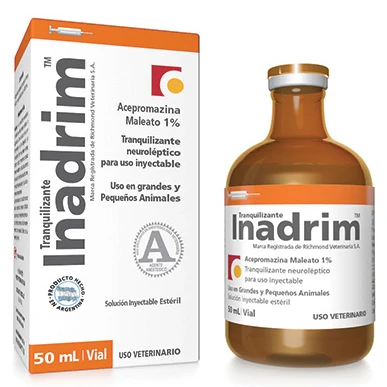
Inadrim
Laboratorio:
Richmond
$13.70
Out of stock
USD
/ unidad
El presupuesto final se adapta según el volumen solicitado y el destino de entrega.
- Distribución oficial habilitada por SENASA Establecimiento oficial y normativas sanitarias vigentes
- Cadena de frío garantizada Monitoreo térmico para biológicos y sueros
- Dirección técnica y asesoramiento veterinario Atención profesional especializada en medicina equina
- Envíos nacionales e internacionales especializados Acondicionamiento térmico y logística segura
Inadrim
$13.70
USD
Out of stock
Injectable neuroleptic tranquilizer containing acepromazine maleate for use in swine, horses, sheep, cattle, dogs, and cats. COMPOSITION Acepromazine maleate: 1 g. Excipients q.s.: 100 ml. ACTION It exerts a sedative effect by depressing the brainstem and cerebral cortex. The animal’s coordinated motor responses are not significantly affected. When used as premedication, it promotes a calm recovery. The primary central action of neuroleptics is the blockade of postsynaptic dopamine receptors in the CNS, increasing the rate of dopamine turnover—that is, its synthesis and degradation in the brain. Acepromazine depresses the portion of the reticular system responsible for regulating body temperature, basal metabolism, emesis, vasomotor tone, hormonal balance, and alertness. It has adrenergic-blocking effects along with weak anticholinergic, antihistamine, and antispasmodic effects. It also potentiates the actions of atropine sulfate, analgesics, hypnotics, and general and local anesthetics. Its antiemetic activity is related to the blockade of dopaminergic receptors in the chemoreceptor trigger zone of the medulla. INDICATIONS A neuroleptic tranquilizer indicated for sedating excited or aggressive animals, as well as for facilitating handling during diagnostic and therapeutic procedures (treating wounds, removing warts, cysts, and stitches) and minor surgical procedures. It is particularly used in combination with local anesthesia for castrations, removal of skin tumors, eye surgery, and turning large animals over. A tranquilizer used alone or in combination with anesthetics used for induction and maintenance, enhancing their effects. It is frequently used as a preanesthetic 20 minutes before general anesthesia. CONTRAINDICATIONS AND WARNINGS In cases of hypovolemia and shock. In animals suffering from tetanus or strychnine poisoning due to its effects on the extrapyramidal system. In epidural anesthesia, as it potentiates the arterial hypotensive effects of local anesthetics. Do not administer this product until one month has elapsed since the animals were treated with organophosphate products (including flea collars). Do not use epinephrine, as acepromazine blocks the central and peripheral effects of catecholamines and may prevent and reverse the actions of epinephrine (epinephrine reversal). However, norepinephrine may be used without risk of potentiating the hypotensive effects of phenothiazines. In geriatric patients, small doses have been associated with a prolonged drug effect. Giant breeds, brachycephalic breeds (Pekingese, Bulldog), and Greyhounds are extremely sensitive to the drug, while terriers are more resistant to its effects. Lower doses of injectable Inadrim should be used in animals with liver problems or weakened heart conditions. Use with caution in very young animals and in those that are debilitated due to the drug’s effect on thermoregulation. Acepromazine has no analgesic effect; Therefore, an appropriate analgesic should be used for pain management. Intravenous administration must be slow. Do not administer to racehorses during the four days prior to competition. The recommended doses and precautions in all cases are at the discretion of the attending veterinarian. The proper storage temperature for this product is between 4 and 25°C, protected from direct sunlight, and stored in a dry, hygienic place. Keep out of the reach of children. Under no circumstances should the product be decanted or its contents exposed to the environment, as this jeopardizes its proper preservation. Verify that storage conditions are adequate prior to use. SIDE EFFECTS Boxers are highly sensitive to the hypotensive and bradycardic effects produced by this drug. Therefore, it should be used with extreme caution and at the lowest possible dose. It is recommended to combine acepromazine with atropine to avoid the bradycardic effects of acepromazine. Acepromazine can trigger seizures in susceptible animals, as it lowers the seizure threshold in the CNS. Therefore, it should not be used in these animals and/or in animals undergoing myelographic studies. Reactions of aggression or excitement may occasionally occur. The hypotensive effect must be taken into account. The same applies to cardiovascular collapse secondary to bradycardia and hypotension. Dogs are more sensitive to these effects than other species. In male dogs of large breeds, it causes penile protrusion corresponding to the drug’s sedative effect. In horses, this effect may last up to two hours. In stallions, in particular, it should be used with caution due to the risk of injury, which could result in inflammation and even permanent paralysis of the penile retractor muscle. Other effects that may be observed in horses include: excitement, sweating, tremors, tachypnea, tachycardia, and, very rarely, seizures. It should not be administered intra-arterially in horses, as this could cause severe excitement or CNS depression, seizures, and death. In cattle, it may cause regurgitation of ruminal contents during induction of general anesthesia. Intramuscular administration may cause transient pain at the injection site. Seizures can be controlled with barbiturates, midazolam, or diazepam. The recommended antagonist for the CNS-depressant effects produced by acepromazine is doxapram. Overdose: Extrapyramidal symptoms (rigidity, tremors, akinesia) or cataleptic symptoms are observed as significant side effects, particularly at high doses. High doses may depress respiratory activity. Generally, overdoses can be managed through patient monitoring and symptomatic treatment. Hypotension may be treated with phenylephrine or norepinephrine. DOSAGE Dogs: Preanesthetic: 0.055 to 0.11 mg per kg intravenously, subcutaneously, or intramuscularly. Do not administer more than 3 mg total. For tranquilization or sedation: 0.025 to 0.03 mg per kg intravenously, subcutaneously, or intramuscularly. The dose may be repeated after 6 to 8 hours if necessary. Intravenous administration should be slow in all species. It takes 15 minutes for the drug to take effect. Cats: Preanesthetic: 0.055 to 0.11 mg per kg intravenously, subcutaneously, or intramuscularly. Do not administer more than 1 mg total. For tranquilization or sedation: 0.025 to 0.03 mg per kg intravenously, subcutaneously, or intramuscularly. The dose may be repeated after 8 to 12 hours if necessary. Horses: For tranquilization or sedation: 4.4 to 8.8 mg per 100 kg intravenously, subcutaneously, or intramuscularly. Preanesthetic: 2 to 5 mg per 100 kg intravenously, subcutaneously, or intramuscularly. Cattle: 0.01 to 0.1 mg per kg intravenously, subcutaneously, or intramuscularly. Sheep and goats: 0.05 to 0.1 mg per kg intramuscularly. Pigs: Preanesthetic: 0.1 to 0.2 mg per kg intravenously, subcutaneously, or intramuscularly. Do not administer more than 15 mg total. For tranquilization or sedation: 0.03 to 0.1 mg per kg intravenously. For short periods of immobilization: 0.5 mg per kg of acepromazine intramuscularly, followed 30 minutes later by 15 mg per kg of ketamine intramuscularly. Atropine (0.044 mg per kg intramuscularly) may be administered to reduce salivation and bronchial secretions. Rabbits: As a tranquilizer: 1 mg per kg intramuscularly; The effect will begin 10 minutes after administration and last for 1 to 2 hours. As a general rule, the dose in mg per kg decreases as the animal’s weight increases
Laboratory
Richmond
Categories
Anesthetics