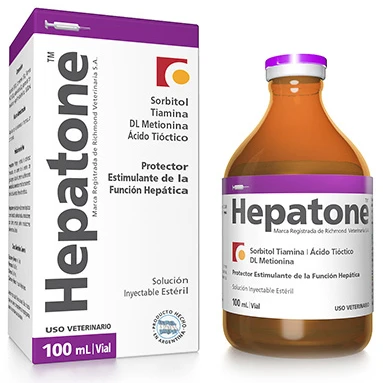
Hepatone
Laboratorio:
Richmond
$19.28
Out of stock
USD
/ unidad
El presupuesto final se adapta según el volumen solicitado y el destino de entrega.
- Distribución oficial habilitada por SENASA Establecimiento oficial y normativas sanitarias vigentes
- Cadena de frío garantizada Monitoreo térmico para biológicos y sueros
- Dirección técnica y asesoramiento veterinario Atención profesional especializada en medicina equina
- Envíos nacionales e internacionales especializados Acondicionamiento térmico y logística segura
Hepatone
$19.28
USD
Out of stock
Injectable solution to protect and stimulate liver function. Sorbitol: 21 g. DI Methionine: 1.5 g. DI Acetylmethionine: 4.5 g. Thiamine hydrochloride: 0.3 g. Thioctic acid: 0.2 g. Excipients q.s.: 100 mL. ACTION : Hepatone protects and stimulates liver function, increasing glycogen stores. It is effective in treating metabolic disorders by promoting normal liver cell function. It has an antitoxic effect (via the S-S group). Thioctic acid promotes liver function by increasing glycogen reserves. It also acts as an antioxidant in numerous adverse or toxic reactions caused by drugs and xenobiotics and has a chelating effect in cases of heavy metal poisoning. Both thioctic acid and thiamine are essential for the normal functioning of the Krebs cycle. Bioavailability: Once administered parenterally, this solution is well tolerated by tissues due to its pH and composition, which ensures complete absorption of the compound. Thiamine is activated after absorption; Its active form is TPP (cocarboxylase), a coenzyme necessary for the oxidative decarboxylation of alpha-ketoacids. Once activated, thiamine participates in oxidative decarboxylation. From a metabolic standpoint, the critical or limiting enzymatic defect in thiamine deficiency lies in the oxidative decarboxylation of pyruvic acid. This reaction is essential for the complete oxidation of glucose through the citric acid cycle. Tissues whose energy depends on glucose or lactate-pyruvate are particularly affected by thiamine deficiency. Methionine, in addition to being the body’s primary donor of methyl groups (it donates them to ethanolamine to form choline), contains sulfur that protects the liver against the harmful effects of certain toxins. Thioctic acid promotes liver function by increasing glycogen stores. It also acts as an antioxidant in numerous adverse or toxic reactions caused by drugs and xenobiotics and has a chelating effect in cases of heavy metal poisoning. Both thioctic acid and thiamine are essential for the normal functioning of the Krebs cycle. INDICATIONS Indicated for liver disorders such as hepatitis, liver failure, and poisoning from lead, mercury, or arsenic. Food poisoning. Ketosis. CONTRAINDICATIONS AND WARNINGS Verify that the product’s tamper-evident seal and storage conditions are appropriate prior to use, and ensure that the product has not expired as indicated by the expiration date on the label. Do not ingest. Keep out of the reach of children. In all cases, dosages and frequency of administration are at the discretion of the treating veterinarian. Store between 4 and 25°C, protected from light, in a clean, hygienic place. Always consult your veterinarian. DOSAGE : Administer intravenously (IV) or by deep intramuscular (IM) injection. Horses and cattle: Administer a total of 50 to 100 ml. Pigs: Administer 10 to 20 ml. Sheep: Administer 5 to 10 ml. Dogs and cats: Administer 1 ml per 10 kg of body weight. In all cases, administer every 24 hours for 5 days or until liver function test results return to normal levels for each species
Laboratory
Richmond
Categories
Liver System