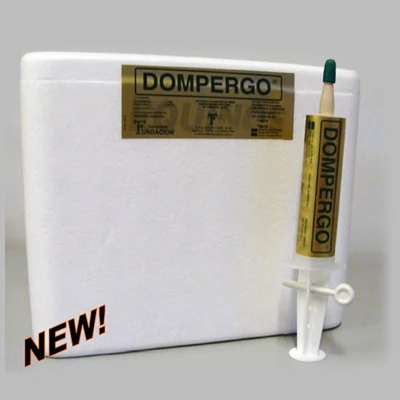
Dompergo
Laboratorio:
Fundación
$16.15
Out of stock
USD
/ unidad
El presupuesto final se adapta según el volumen solicitado y el destino de entrega.
- Distribución oficial habilitada por SENASA Establecimiento oficial y normativas sanitarias vigentes
- Cadena de frío garantizada Monitoreo térmico para biológicos y sueros
- Dirección técnica y asesoramiento veterinario Atención profesional especializada en medicina equina
- Envíos nacionales e internacionales especializados Acondicionamiento térmico y logística segura
Dompergo
$16.15
USD
Out of stock
Dompergo Composition: Suspension in a water-repellent vehicle. Contains 6 g of domperidone. Excipients q.s. to 100 mL. Therapeutic action: DOMPERGO is a selective dopamine D² receptor antagonist Indications: It is indicated for: A) The prevention and treatment of poisoning caused by indole-derived alkaloids (or ergot alkaloids) (E+). Routine management of pastures intercropped with natural ryegrass or fescue exposes horses to a considerable load of this type of mycotoxin, which is produced (biosynthesized) by symbiotic endophytes in the former case and by Neotyphodium lolii and in fescue, by Neotyphodium coenophialum or another fungus parasitizing the spikes (Claviceps sp.), in other grasses. The quantity and quality of the alkaloid produced depend on environmental factors (drought, humidity, temperature, etc.), soil type, management practices (overgrazing, competition with other grasses, fertilization, planting season, etc.), and other variables specific to each animal in the population. These indole alkaloids produce a number of clinical signs in different species. In mares, they affect the reproductive tract at various stages, manifesting as agalactia, placental abnormalities, prolonged labor, resorption, and absence of estrus, among other signs. In the pregnant foal, numerous pathologies are also observed, including respiratory failure, osteoarticular abnormalities, decreased serum immunoglobulin levels, and perinatal death. Once established, the signs in foals (primarily the osteoarticular ones) cannot be reversed; Therefore, DOMPERGO is primarily indicated as a prophylactic or therapeutic measure for mares exposed to this mycotoxin. This can be summarized as follows: 1) DOMPERGO should be administered 35 days prior to the expected date of foaling. Treatment should continue until the day of foaling, which normally occurs on or before the estimated date. If foaling does not occur within the predetermined period—that is, more than 7 days past that date—discontinue treatment. If, on the other hand, foaling occurs as predicted, colostrum and milk production tend to be normal or abundant. If necessary, treatment may be continued at the discretion of a veterinarian. 2) DOMPERGO is indicated for mares that begin lactation with reduced or absent milk production. Treatment should be continued based on the clinical presentation and professional judgment, but it is generally not necessary to extend it beyond 20 days. 3) DOMPERGO is also administered to mares showing signs of low ovarian activity. In general, ovarian follicular growth and ovulation occur 15 to 17 days after treatment begins and should be assessed by palpation. Once bred, it may be necessary to continue treatment for the first 60 days to maintain the primary corpus luteum until progesterone production begins from the accessory corpus luteums, which depend on chorionic gonadotropin (days 35 to 50). Blood hormone testing (progesterone and estrogens) serves as a complementary diagnostic tool, as concomitant treatment with synthetic progesterone may be required. If a pregnant mare has ingested toxin-containing grasses prior to the administration of DOMPERGO, the drug does not correct any existing defects (especially osteoarticular defects) in the fetus. B) DOMPERGO is indicated as a milk production inducer, primarily in fillies with low milk production, provided that the cause is not the aforementioned toxin exposure. The duration of treatment depends on the treating veterinarian’s judgment, but generally does not need to exceed 20 days. The primary clinical use of domperidone in other species and in humans has been as a prokinetic and antiemetic. Although this function has no direct application in horses, it has shown great potential for both clinical and experimental use in gastrointestinal surgery, since its proper administration prevents postoperative ileus. Its effects focus on the mechanical and functional restoration of gastro-duodenal evacuative peristaltic coordination. Routes of administration: Oral. No prior preparation is required. It comes in a ready-to-use dosing device. Dosage: The clinically established dose of domperidone for horses is 1.1 mg per kilogram of body weight, regardless of age or sex. It is recommended to administer it prior to feeding. DOMPERGO has a potency of 60 mg/ml. Its graduated dispenser holds 40 mL (1 mL = 55 kg body weight) and features a locking mechanism every 10 mL (10 mL = 600 mg), with 10 mL being the dose for a 550-kg horse (routine dose). In total, each syringe provides 4 routine doses (2,400 mg = 2,200 kg body weight). DOMPERGO is administered every 24 hours. Drug interactions, side effects, and contraindications: DOMPERGO has a wide safety margin at the recommended dose and frequency. It should be noted that in conditions requiring high levels of bioavailability, it is advisable to administer up to 6 times the therapeutic dose to overcome the significant retention caused by enterohepatic metabolism (first-pass metabolism). This has not been tested in horses. Concomitant administration of anticholinergic medications may counteract the action of domperidone. Atropine should not be administered together with DOMPERGO. The drug’s normokinetic action may influence the bioavailability of other drugs; However, at usual doses, this effect is negligible. Although the metabolic pathway in horses has not been described, CYP3A4 inhibitors—a subgroup of cytochrome P450—such as azole antifungals (ketoconazole), macrolide antibiotics (erythromycin, clarithromycin, or azithromycin), protease inhibitor medications (saquinavir, ritonavir, lopinavir, and others), and nefazodone, modify the bioavailability of domperidone, increasing its Cm nearly threefold, in experimental animals and in humans. Precautions: Horses undergoing treatment may be kept on pastures and/or forage, although excessive fiber intake should be avoided to prevent accelerated intestinal transit, as the medication promotes intestinal motility. When administered at the recommended dose and frequency, it presents no toxicity whatsoever. DOMPERGO should not be administered to humans or to any animal species other than those for which it is expressly indicated. Packaging: Syringe with a 40-ml graduated scale
Laboratory
Fundación
Categories
Antibiotics,
Equine Reproduction
Sale condition
Prescription required