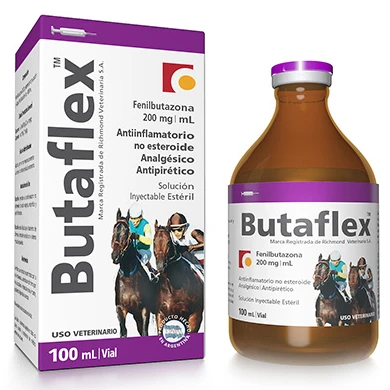
Butaflex
Laboratorio:
Richmond
$15.66
Out of stock
USD
/ unidad
El presupuesto final se adapta según el volumen solicitado y el destino de entrega.
- Distribución oficial habilitada por SENASA Establecimiento oficial y normativas sanitarias vigentes
- Cadena de frío garantizada Monitoreo térmico para biológicos y sueros
- Dirección técnica y asesoramiento veterinario Atención profesional especializada en medicina equina
- Envíos nacionales e internacionales especializados Acondicionamiento térmico y logística segura
Butaflex
$15.66
USD
Out of stock
Nonsteroidal anti-inflammatory drug (NSAID) based on phenylbutazone for injectable use in dogs and horses. Phenylbutazone: 200 mg. Excipients q.s.: 1 ml. ACTION : Nonsteroidal anti-inflammatory drug with analgesic, antipyretic, and anti-inflammatory effects. Bioavailability: Following administration, the drug is distributed throughout the body, with higher concentrations in the liver, heart, kidneys, and lungs. It binds to plasma proteins at a rate of 99%. Phenylbutazone can displace other drugs that bind to plasma proteins, such as warfarin, which may lead to acute bleeding, since pharmacological agents are therapeutically inactive when bound to proteins, whereas displacement from this binding site releases the drug to diffuse to its site of action, leaving it free and exposed to metabolism and excretion. The serum half-life in horses ranges from 3.5 to 6 hours, in cattle 40 hours, and in dogs from 2.5 to 6 hours; Like aspirin, it is dose-dependent. However, therapeutic efficacy can last for more than 24 hours, likely due to the irreversible binding of phenylbutazone to cyclooxygenase. In horses and other species, phenylbutazone is almost completely metabolized, first to oxyphenbutazone (the active metabolite) and to gamma-hydroxyphenylbutazone. Oxyphenbutazone has been detected in equine urine 48 hours after a single dose. In dogs, oxyphenbutazone persists in the urine for at least 48 hours following an oral dose of 8.9 mg/kg, but cannot be detected in urine samples collected 72 hours later. The unchanged drug (phenylbutazone) is not detected in 36-hour urine samples from dogs. Both phenylbutazone and oxyphenbutazone cross the placenta and are excreted in milk. Since phenylbutazone is a weak acid, it is generally suspected that this drug may be preferentially excreted more rapidly in alkaline urine, whereas in acidic urine, excretion would be slower and more prolonged. The greater pharmacological activity of phenylbutazone appears to result from the formation of its active metabolite, oxyphenbutazone. Oxyphenbutazone has essentially the same pharmacological effects, therapeutic uses, and toxicological effects as phenylbutazone. INDICATIONS Indicated for the treatment of various disorders associated with the musculoskeletal system. Indicated for acute laminitis; Arthritis, spondylitis, osteoarthritis, tendinitis, acute tenosynovitis, capsulitis, bursitis, and rheumatism, reducing pain and tissue inflammation, as well as fever in viral infections. It is used to extend the reproductive life of older stallions suffering from osteoarthritis and other painful conditions in the legs. In dogs, it is also indicated for acute uveitis, chorioretinitis, endophthalmitis, and injuries to the cornea and eyeball. CONTRAINDICATIONS AND WARNINGS Do not administer to animals hypersensitive to the active ingredient. Do not administer to animals with preexisting hematological disorders or gastrointestinal ulcers. It is contraindicated in animals with hepatic, renal, or cardiac insufficiency. Safety during pregnancy has not been established; However, it may be used when the benefits of therapy outweigh the risks. Use with caution in ponies, as they are more susceptible to adverse effects. Phenylbutazone and its active metabolite, oxphenbutazone, may displace other drugs and thus affect their serum levels and duration of action, such as oral anticoagulants, other anti-inflammatory agents, and sulfonamides. Phenylbutazone increases the half-life of penicillin G or Iitio and antagonizes furosemide. It may interfere with thyroid function tests by competing with thyroxine for protein binding sites. Ensure that the product is administered exclusively via the indicated routes. Subcutaneous or intramuscular administration of Butaflex injection is highly irritating and may even lead to necrosis. Do not exceed the doses recommended on the label. Intravenous administration must be performed slowly. Do not ingest. Keep out of the reach of children. In all cases, dosages and frequency are at the discretion of the treating healthcare professional. Store between 4 and 25°C, protected from light, in a hygienic location. SIDE EFFECTS May cause gastrointestinal effects (dyspepsia, ulcers, diarrhea, anorexia), decreased renal blood flow, and blood dyscrasias. DOSAGE Horses: Administer 1 to 2 g per 454 kg (2.2 to 4.4 mg per kg or 0.55 to 1.1 ml per 50 kg) per day on the first day, as a single dose. Then reduce the dose by half for four additional days. Do not exceed 4 g per day. Dogs: Administer 22 mg per kg per day (1.1 ml per 10 kg) divided into 3 doses. Do not exceed 800 mg per day, regardless of the dog’s weight. Notes: Intravenous administration should be limited to only five consecutive days. If treatment needs to be extended, continue it orally. The injection should be administered slowly. Duration of treatment: It is recommended not to exceed 5 days of treatment. If there is no significant clinical improvement by the end of the 5th day, the diagnosis and treatment should be reevaluated