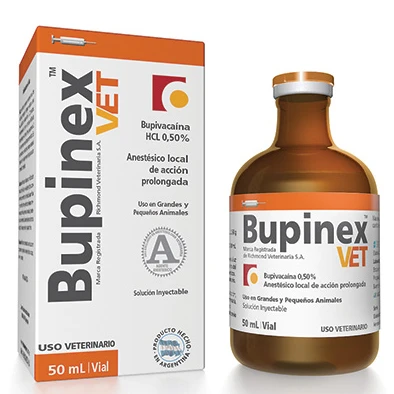
Bupinex Vet
Laboratorio:
Richmond
$8.55
Out of stock
USD
/ unidad
El presupuesto final se adapta según el volumen solicitado y el destino de entrega.
- Distribución oficial habilitada por SENASA Establecimiento oficial y normativas sanitarias vigentes
- Cadena de frío garantizada Monitoreo térmico para biológicos y sueros
- Dirección técnica y asesoramiento veterinario Atención profesional especializada en medicina equina
- Envíos nacionales e internacionales especializados Acondicionamiento térmico y logística segura
Bupinex Vet
$8.55
USD
Out of stock
Long-acting local anesthetic and analgesic. COMPOSITION Bupivacaine: 0.5 g. Excipients q.s.: 100 ml. ACTION A local anesthetic belonging to the amide group. Its action is prolonged, lasting between 4 and 8 hours after administration. It is 2 to 4 times more potent than lidocaine, with an even wider safety margin. The effects of bupivacaine begin 3 to 20 minutes after administration. INDICATIONS It is a local anesthetic that allows for great safety and versatility, making it the first choice for all types of minor, long-duration surgical procedures of low to moderate complexity. Its anesthetic potency is optimal, and it also provides a potent postoperative analgesic effect. Local infiltration anesthesia and/or analgesia of tissues and structures (concentric, eccentric, deep, superficial, and ring techniques). Epidural anesthesia and/or analgesia, via single-dose or continuous administration. Intercostal nerve blocks. Intrapleural anesthesia and/or analgesia. Intravenous regional anesthesia (Bier block). Intra- and/or periarticular infiltrative anesthesia and/or analgesia. Regional or trunk nerve blocks; Obstetric, urogenital, reconstructive, and ophthalmic surgery. Peripheral nerve blocks. Diagnostic perineural, trunk, and multitrunk anesthesia CONTRAINDICATIONS AND WARNINGS Do not use on infected tissues (abscesses) or in recently traumatized areas where pus, hematoma, and/or effusions are present. Do not mix in the same vial or syringe with any other compound other than those suggested to reduce the original concentration. Do not ingest. Keep out of the reach of children. The suggested doses and warnings are at the discretion of the attending veterinarian. It should be noted that, although very rare, there have been reports of patients who are refractory to the use of local anesthetics. This situation is observed more frequently with epidural administration. Do not use in infected tissues (abscesses) or in recently traumatized areas with pus, hematoma, and/or effusions. Under these circumstances, the tissue environment has a slightly acidic local pH, which will prevent the hydrolysis of the anesthetic’s acid group and the release of the alkaloid. Its use as a topical or surface anesthetic on mucous membranes is not indicated. Always perform an aspiration maneuver prior to infiltrating tissues and/or structures with the medication, thereby ensuring that the product is not administered intravenously. The intravenous route should be used exclusively for performing the intravenous regional anesthesia technique (Bier block). SIDE EFFECTS Iatrogenic intravenous administration may cause symptoms such as bradycardia, arrhythmias, ventricular fibrillation, and hypotension. DOSAGE The general reference dose is 0.25 mg per kg of body weight, equivalent to 0.05 ml per kg of body weight. Epidural anesthesia: Dogs and cats: 1 mL per 4.5 kg of body weight. Reduce the dose by up to 30% in obese animals. Pigs: 1 ml per 10 kg of body weight. Horses: 5 to 7 ml total to achieve a posterior block. Exceeding this dose will result in an anterior block. Cattle: 8 to 10 ml total to achieve a posterior block. With an analgesic effect lasting approximately 2 hours. To achieve an anterior block, with the animal in a supine position, a total of 50 to 60 ml should be administered
Laboratory
Richmond
Categories
Pain relievers