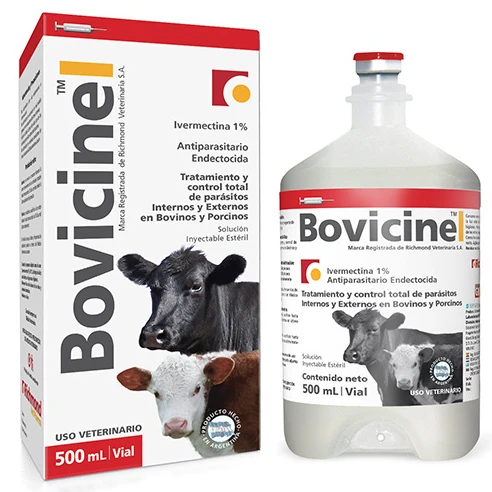
Bovicine I (Ivermectina 1%)
Laboratorio:
Richmond
$24.50
Out of stock
USD
/ unidad
El presupuesto final se adapta según el volumen solicitado y el destino de entrega.
- Distribución oficial habilitada por SENASA Establecimiento oficial y normativas sanitarias vigentes
- Cadena de frío garantizada Monitoreo térmico para biológicos y sueros
- Dirección técnica y asesoramiento veterinario Atención profesional especializada en medicina equina
- Envíos nacionales e internacionales especializados Acondicionamiento térmico y logística segura
Bovicine I (Ivermectina 1%)
$24.50
USD
Out of stock
Injectable endectocidal antiparasitic solution for cattle and swine; COMPOSITION; Ivermectin: 1 g; Excipients and formulation agents q.s.: 100 ml; ACTION; : Endectocide; Its active ingredient (ivermectin) is a molecule belonging to the avermectin family, isolated from the fermentation of Streptomyces avermitilis, known for its potent and broad-spectrum antiparasitic action against both internal parasites (roundworms) as well as external parasites (scabies, lice, and other mites and insects). Ivermectin acts at the nerve endings themselves or at the junction between a nerve fiber and a muscle fiber; Ivermectin stimulates the massive release at this site of a chemical compound, gamma-aminobutyric acid (GABA), which acts as a neurotransmitter. The presence of large amounts of GABA at the synapse leads to a complete blockade of the specific receptors located at the nerve endings, which interrupts the parasite’s nerve impulses and consequently causes its death by paralysis; This unique mechanism of action is characteristic of ivermectin and distinguishes it from other classes of antiparasitic agents; INDICATIONS; It is indicated for the treatment and control of parasitic infections in cattle and swine. Its active ingredient (ivermectin) is known for its potent parasiticidal action and broad spectrum of activity, both against internal parasites (Ascaris suum, Hiostrongylus rubidus, Strongylloides ransomi, Metastrongylus spp.) as well as external parasites (scabies, lice, and other mites and insects); CATTLE:; It is especially indicated for the treatment and control of the following parasite species; : - Gastrointestinal worms (adults and larvae): Ostertagia ostertagi (including arrested larvae), O. iyrata, Haemonchus placei, Trichostrongylus axei, T. columbiformis, Cooperia oncophora, C. punctata, Bunostomum phlebotomum, Oesophagostomum radiatum (adults), Nematodirus helvetianus (adults), N. spathiger, Strongyloides papillosa; Lungworms (adults and larvae): Dictyocaulus viviparus; Ura/Hypoderma (parasitic forms): Dermatobia hominis, Hypoderma bovis, H. lineatus; Paraphilaria: Paraphilaria bovicola; Eye worm: Thelazia spp; Lice: Lignonatus vituli, Haematophinus eurysternus; Mange: Psoroptes communis var. bovis, Sarcoptes scabiei var. bovis; It is also indicated to help control parasitic; Infections caused by; : - Louse: Damalinia bovis; Scabies: Caused by Chorioptes bovis; SWINE:; It is specifically indicated for the treatment and control of the following parasite species; :; Gastrointestinal worms: Ascaris suum (adults and larvae), Hyostrongylus rubidus (adults and larvae), Strongylloides ransomi (adults and larvae); Lungworms: Metastrongylus spp; Lice: Haematophinus suis; Mange: Sarcoptes scabiei var. suis; CONTRAINDICATIONS AND WARNINGS; Do not administer to animals in poor general condition or under conditions of intense stress; Do not administer intravenously or intramuscularly; Adjust the dose according to each animal’s weight to avoid overdosing; Do not ingest; Keep out of the reach of children and pets; Do not mix in the same syringe or container with any substance other than the product; Dispose of the container after use and place it in waste receptacles. Protect the environment; Do not ingest. Keep out of reach of children; Observe aseptic and antiseptic precautions before and during application of the product; SIDE; EFFECTS At the recommended doses, Bovicine does not cause adverse effects in cattle and swine, since the primary neurotransmitter at the peripheral level in mammals is acetylcholine, not GABA, which provides a high margin of safety for the technician when administering the product; DOSAGE; Administer subcutaneously only; Cattle: 200 micrograms per kg of body weight. Equivalent to 1 ml per 50 kg of body weight; Swine: 300 micrograms per kg of body weight. Equivalent to 1 ml per 33 kg of body weight
Laboratory
Richmond
Categories
Pest Control Products